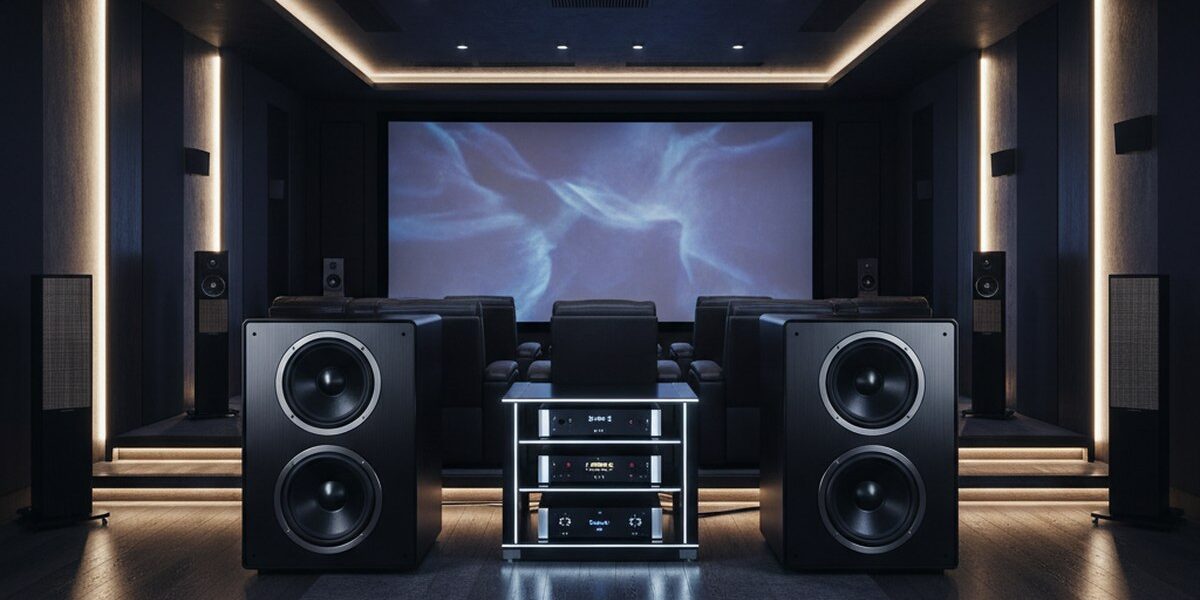
Subwoofer in a home theater: how to place it correctly
Correct home theater subwoofer placement — it's not a question of “where to put the box,” but an engineering task about the distribution of modal pressure in a confined volume. In a typical room of 25–40 m², 8–14 natural modes are formed at frequencies below 120 Hz, and a subwoofer that falls into a standing wave node loses up to 20 dB at the resonant frequency. Subjectively, the viewer hears “flabby bass, no punch” — although the emitter itself is working normally. Below, we analyze how the installation location is related to the physics of the room and which schemes actually work.
Why is subwoofer placement more important than the model itself?
At low frequencies, the wavelength is comparable to the room size: for 40 Hz it is 8.5 meters, for 80 Hz — 4.25 m. The subwoofer does not emit sound “at the viewer”; it excites the entire air volume. Then three effects come into play:
- Reinforcement from boundaries. Installation against one wall adds +3 dB, in a corner — up to +9 dB due to in-phase reflection summation.
- Modal nodes and antinodes. In the center of the long side of the room, at the frequency of the first axial mode, the pressure drops to zero — the viewer at this point will not hear any bass at all.
- Group delay. A subwoofer in the far corner relative to the listener adds 15–25 ms of delay, and the “impact” comes after the image on the screen.
The standard calculation using the Thiele–Small method (1965, sine signals) describes only the speaker itself in a free field and yields an efficiency of 1.5–5%. It does not account for what happens to the wave after it leaves the enclosure. Therefore, professional calculations are based on the impulse response — Dirac's function — which shows a full correlation between objective measurements and subjective perception at a specific listening point.
What placement schemes work in a home theater?
There are four proven configurations. The choice depends on room geometry, number of seats, and budget.
1. Single subwoofer in the front quarter
Basic option. The subwoofer is not placed strictly in the center under the screen (the center is the node of even modes), but is shifted 1/4 of the room's width from the side wall. The distance from the front wall is 30–60 cm. Suitable for rooms up to 25 m² with one row of seats.
2. Two subwoofers diagonally
One in the front left, the second in the back right (or mirrored). This scheme averages the modal response: the antinodes of one subwoofer fall on the nodes of the other. The unevenness of the frequency response in the listening area is reduced from a typical ±12 dB to ±4 dB without any electronic correction.
3. Four subwoofers according to the Tula–Welty scheme
One in the middle of each wall or in the corners. This is the standard for cinemas with two or three rows of seats. Modal excitation is symmetrical, the frequency response difference between the extreme and central seats is less than 2 dB.
4. Double stack at the front wall
Two subwoofers are placed close to each other. This doubles the radiating surface, provides +6 dB sensitivity, and reduces distortion by 3 dB at the same SPL. A good solution for oddly shaped rooms where symmetrical placement is not possible.
How to find the optimal point without measurements?
There is a 'sub crawl' technique — temporary but effective. The subwoofer is placed in the listener's position, a test track with even bass is played, and the listener crawls around the perimeter of the room. The point where the bass sounds most even and dense is the place for the subwoofer, based on the principle of acoustic reciprocity.
The method yields better results than simply installing “where it fits,” but it does not replace instrumental calculation. Sub crawl finds a local optimum for loudness but does not control group delay, phase dips at the junction with front speakers (usually 80 Hz), and modal ringing after signal cutoff. For a system costing more than 500,000 rubles, the difference between “acceptable” and “correct” justifies the instrumental approach.
What does calculation based on a 3D scan of the premises provide?
3D scanning records geometry with an accuracy of 2–3 mm: actual dimensions, niches, beams, protrusions, surface materials. A numerical model is built from the scan using the finite element method, and for each possible subwoofer point, the impulse response in the seating area is calculated.
As a result, the client receives a room map with markings: where the subwoofer will provide a flat frequency response of ±3 dB in the 20–120 Hz band, where a dip at 55 Hz will appear, where the delay will exceed the Haas threshold. Next, a solution is chosen based on the specific budget: a single point with a compromise or a scheme of two to four subwoofers with symmetry. Without a scan, this is a trial-and-error process with the risk of rebuilding the room twice.
What errors are most common?
- Subwoofer in a cabinet or niche. Resonator inside a resonator, distortions up to 15% and a dip in output at 40–60 Hz.
- Rigid connection to the floor. The wooden floor starts to radiate itself, and a hum appears in adjacent rooms. The solution is anti-resonant spikes or a platform on spring supports.
- Matching the crossover frequency with the room mode. If the crossover is set to 80 Hz, and the first room mode is 78 Hz, at this frequency you will get either a +10 dB hump or a dip.
- Symmetrical pair without phase shift. Two subwoofers against one wall work as one with double the power, without providing an advantage in terms of frequency response uniformity.
Frequently asked questions
Can I place a subwoofer behind the sofa?
Yes, if the viewer is not sitting flush against the backrest. The distance from the emitter to the head should be at least 1.5 meters, otherwise bass localization appears — the brain determines the direction, and the effect of “bass coming from the screen” is destroyed.
Do you need two subwoofers if the room is only 18 m²?
In most cases, yes. A small room has a sparser mode grid, and the dips between them are deeper. Two subwoofers in opposite corners average the frequency response more effectively than one subwoofer with auto-correction.
At what height should the subwoofer be placed?
For frequencies below 80 Hz, height is not critical – the wavelength is greater than the ceiling height. But if the crossover is above 100 Hz, the subwoofer should be raised by 30–40 cm so that the radiation is not absorbed by carpets and pillows.
Will electronic correction help if the location is poorly chosen?
Correction removes peaks but does not restore dips: you cannot add energy at a frequency where it is physically absent. Therefore, correct placement is always primary, and correction is a final adjustment of ±3 dB.
Need acoustics advice?
Leave your contact — we'll respond within 30 minutes and calculate the cost