How to choose acoustic materials for a living space
Why acoustics are more important than ever?
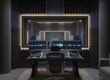
The market for home theaters and multimedia systems is growing. People want to get the most out of their investments in expensive equipment. But they often forget that even the most perfect audio system is powerless in an unprepared room. We regularly encounter situations where a client has invested millions in equipment, but the sound is still 'not right'. In the cinema project on Leninsky Prospekt, for example, the owner complained about boomy bass and unintelligible dialogues. It turned out that the problem was not in the subwoofer, but in the lack of proper low-frequency treatment of the walls and ceiling.
Simply "wallpapering" the walls with foam rubber is not a solution. This approach, unfortunately, is often encountered, but it does not provide a systemic result. Without a professional approach to choosing acoustic materials for a living space, you risk wasting money and not getting the desired sound quality.
Key concepts in room acoustics
Before delving into the selection of specific materials, let's understand the basic terms we use at 360° Space Acoustic.
Reverberation (RT60)
This is the time it takes for the sound level in a room to decay by 60 dB after the sound source is turned off. Too long RT60 makes the sound boomy and indistinct. Too short - "dry" and unnatural. For a home theater, we need a balance. When measuring RT60 in one of our projects, a typical living room of 25 m², without any acoustic treatment, showed an RT60 of 1.2 seconds at mid-frequencies, which is very high for comfortable music listening, let alone for movies.
Sound absorption and sound diffusion
Sound-absorbing materials convert sound energy into heat, reducing reflections and reverberation. This helps combat echo and rumble. Sound-diffusing (diffusers) - break up sound waves, distributing them evenly throughout the room, which creates a more voluminous and natural sound, without the effect of a "dead" room. It is important to understand that both types of materials are needed for quality acoustics.
Impulse response
This is our main tool. We use impulse response (Dirac function) to analyze the acoustic properties of a room. This allows us to obtain a full correlation between objective measurements and subjective sound perception. Unlike the standard Thiele–Small method of 1965, which uses sine signals and gives an efficiency of only 1.5–5%, impulse response gives us a much more accurate and complete picture. It's like looking at a picture in 4K instead of a black and white photograph.
How to choose acoustic materials for a living space: a step-by-step approach from 360° Space Acoustic
The choice of acoustic materials is not a «guessing game«, but a precise engineering calculation. Especially when it comes to home theaters.
Step 1: 3D scanning and acoustic diagnostics
We start with a detailed 3D scan of the room. This is not just tape measurements, but the creation of an accurate digital model of your room. This model is the basis for all further calculations. Then, using specialized equipment, we measure the impulse response of the room. This allows us to identify all acoustic defects: standing waves, flutter echo, excessive reverberation at certain frequencies. Based on this data, we build a detailed acoustic map.
Step 2: Modeling and calculation
With a 3D model and impulse response data, our engineers proceed to acoustic modeling. We use specialized software that allows us to 'build' a virtual home theater and test various acoustic treatment options. We can accurately calculate what materials, in what quantity, and where they should be placed to achieve the target acoustic parameters. For example, for a cinema in a private house near St. Petersburg, we modeled several options for placing bass traps to suppress resonance at 60 Hz, which was critical for deep and clear bass.
Step 3: Material selection
Only after precise calculations do we move on to selecting specific acoustic materials for a living space. We work with a wide range of materials from leading manufacturers, but the choice is always dictated by the specific tasks of the project. These can be:
- Mineral wool panels or acoustic foam: for absorbing mid and high frequencies. They differ in density, thickness, and appearance.
- Bass traps: are critically important for controlling low frequencies, which are the most difficult problem in small rooms. They can be corner, wall-mounted, or even built-in.
- Diffusers (QRD, PRD): for sound diffusion and creating a spacious soundstage. They prevent «dead zones and make the sound more lively.
- Perforated panels: are often used for aesthetic masking of absorbent materials, while also possessing acoustic properties.
- Acoustic curtains and carpets: can be additional elements for fine-tuning reverberation, especially at high frequencies.
Step 4: Integration and design
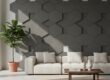
It is important that acoustic solutions not only work effectively but also harmoniously fit into the interior. We offer various finishing options for acoustic panels so that they look like part of the design solution, and not as foreign elements. In one of our client's projects from Yekaterinburg, where we made a listening room, all perforated panels were finished with veneer of valuable wood species to preserve the minimalist Scandinavian style.
What to look for when choosing acoustic materials?
Absorption efficiency in the required frequency range
Not all "acoustic" materials are equally useful. Some absorb high frequencies well but are completely useless at low frequencies. For a home theater, it is critical to control the entire spectrum, especially bass. Our calculations always show which material and with what absorption coefficient is needed for a specific frequency. Do not trust "universal" solutions without accurate data.
Fire safety and environmental friendliness
This is especially important for living spaces. All materials we use at 360° Space Acoustic have the necessary fire safety certificates and comply with environmental standards. No components that emit harmful substances.
Aesthetics and integration into the interior
Acoustic treatment should be invisible or, conversely, become an accent element of the design. We always discuss with the client the appearance of the materials, the possibility of painting them, upholstering them with fabric, or hidden installation. We understand that a home theater is part of your home, and it should look impeccable.
Correct installation
Even the best acoustic materials for a living space will be useless if installed incorrectly. Gaps, mounting errors, incorrect placement - all this will negate their effectiveness. Our specialists have extensive experience in installation work, which guarantees the correct installation of each element.
We at 360° Space Acoustic operate throughout Russia, with offices in Moscow and St. Petersburg. Our experts are ready to help you create the ideal acoustic space in your living area.
Frequently asked questions
Q: Can I choose acoustic materials for a living space myself?
A: Without professional acoustic measurements and calculations, self-selecting acoustic materials for a living space is extremely risky. You can spend money on ineffective solutions. We recommend starting with a professional diagnosis that will show the real picture.
Q: What materials are best for bass control?
A: For controlling low frequencies (bass), bass traps are most effective. These are special structures designed to absorb low-frequency waves. Their type and size are selected individually based on acoustic measurements, such as impulse response.
Q: How much will acoustic treatment change the appearance of the room?
A: Modern acoustic materials for a living space can be integrated to be virtually invisible or, conversely, become part of the design. We offer various finishing, painting, and hidden installation options to preserve or enhance the aesthetics of your interior.
Need acoustics advice?
Leave your contact — we'll respond within 30 minutes and calculate the cost